
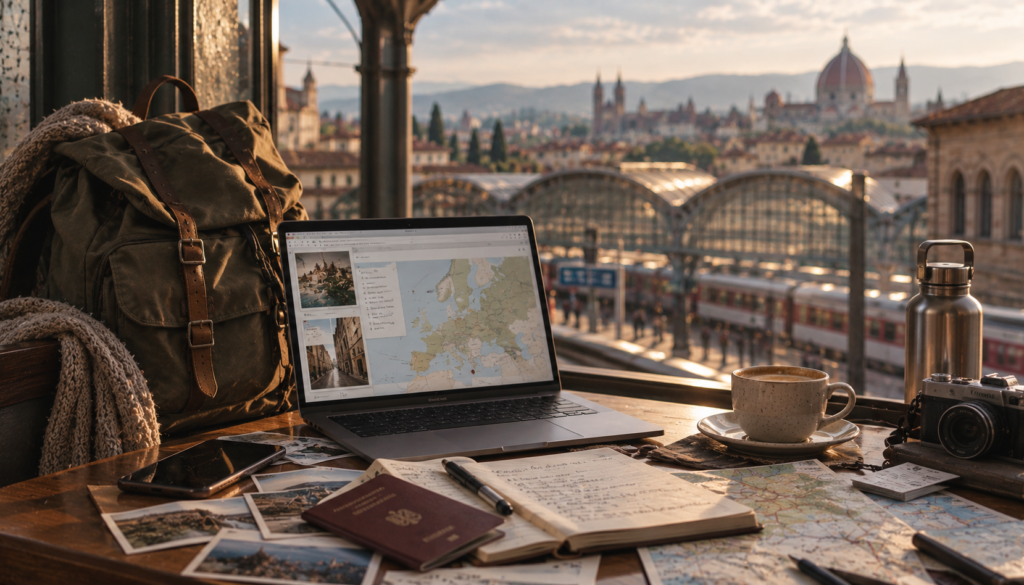
When I first started dreaming about becoming a digital nomad, I imagined a rather simple life.
A laptop, a suitcase, a reliable internet connection, and the freedom to wake up somewhere new whenever I felt like it.
No apartment to maintain. No office to report to. No permanent address tying me to a place I no longer wanted to live.
Just me, my work, and the world waiting to be explored.
Sounds wonderful, doesn’t it?
Well, apparently, I forgot to invite bureaucracy along on this adventure.
As I’m preparing to leave Germany in February 2027, I’ve been researching what it actually takes to become a digital nomad. And I’ve discovered that the freedom to travel doesn’t necessarily come with the freedom to exist without a permanent home.
At least not when governments, tax offices, insurance companies, and business registrations are involved.
And the more I research, the more questions I seem to have.
The Problem With Having No Home Base
Let’s start with the situation I’m trying to create.
I’m a European citizen, currently living in Germany. I want to leave, travel around Europe, and hopefully earn a living through various online activities.
I’m not planning to move permanently to Portugal, Spain, or any other particular country. At least not yet.
I want to spend some time here, a few months there, and see where life takes me.
The idea is to have no permanent home base.
But here’s the problem: while I might be perfectly happy not belonging to any particular country, the administrative systems don’t seem to share my enthusiasm.
Where do I pay taxes?
Where do I register a business?
Which country is responsible for my health insurance?
And what address do I give to the bank, my clients, or the authorities?
Suddenly, the dream of living out of a suitcase becomes a surprisingly complicated administrative project.
Option 1: Keep Everything in Your Home Country
The most obvious solution seems to be keeping your administrative base in the country you’re leaving.
In my case, that would mean Germany.
I could potentially register a business here, continue dealing with the German tax authorities, and travel while working remotely.
There are certainly advantages.
I understand the language, I’m familiar with the system, and I wouldn’t have to learn an entirely new country’s administrative procedures.
But there’s one rather significant problem.
I want to leave Germany.
Not just physically, but administratively, too.
I don’t particularly want to keep paying for a system I’m no longer living in simply because it’s convenient to remain connected to it.
And there’s another complication: registering a business in Germany and maintaining a German tax residence aren’t necessarily the same thing. Neither is having a German mailing address.
I could leave the country, deregister my residence, and still have tax obligations depending on my circumstances.
So, while this option might be the simplest for some digital nomads, it doesn’t necessarily provide the clean break I’m looking for.
Option 2: Move Your Administrative Home to Another Country
Another possibility would be to establish residency somewhere else.
Perhaps in a country with lower living costs, a simpler system for self-employed people, or more favorable taxes.
Portugal, Spain, Romania, Estonia… there are several countries worth investigating, depending on what you’re looking for.
The idea would be to establish a legitimate base in one country while continuing to travel.
This could make some things easier. I’d have an address, a place to register a business, and potentially a clearer arrangement for taxes and insurance.
But it also raises a rather obvious question.
If I don’t actually want to live there, why would I move there?
Establishing residency generally involves more than choosing a country from a list and putting its name on official documents.
And while I might be willing to spend some time somewhere to set things up properly, I’m not particularly enthusiastic about creating another home base before I’ve even had the chance to discover where I might want to live.
It feels a little like solving the problem of being tied to one country by tying myself to another.
Option 3: Register a Business Abroad Without Moving There
This is where things started getting interesting.
What if I didn’t need to register my business in the same country where I live?
There are options for establishing companies abroad, including Estonia’s e-Residency program and certain business structures outside Europe, such as an American LLC.
At first glance, that sounds almost perfect.
A company that can operate internationally while its owner travels.
But the more I looked into these possibilities, the more I realized that registering a company somewhere doesn’t automatically make my personal obligations disappear.
The company might be registered in one country, but I could still have tax responsibilities somewhere else.
And what about health insurance? Social security? My personal tax residence?
Apparently, a business can have an address without necessarily solving the question of where its owner belongs.
So much for my brilliant loophole.
Option 4: Become a Nomad Without a Fixed Residence
Now we arrive at the option that originally sounded the most appealing to me.
What if I simply deregistered from Germany, didn’t register anywhere else, and traveled?
After all, as an EU citizen, I have considerable freedom to move between European countries.
Why shouldn’t I be able to spend a few months in Spain, continue to Portugal, visit Italy, and work online along the way?
And if I don’t spend more than 183 days in any one country, wouldn’t that mean I’m not a tax resident anywhere?
Unfortunately, it’s not that simple.
The famous 183-day rule isn’t some magical international agreement that allows travelers to avoid tax residency altogether.
Different countries have different rules, and the time you spend somewhere is only one of the factors that can matter.
Your personal connections, available homes, economic interests, and where you actually conduct your business may also become relevant.
So avoiding a long stay in any single country doesn’t necessarily mean avoiding tax obligations.
And even if I could establish that I wasn’t a tax resident anywhere, I’d still have to work out how to run a legitimate business, invoice clients, and arrange insurance.
It seems that being homeless by choice doesn’t automatically make you free from paperwork.
Who would have thought?
And Then There’s Health Insurance
I have to admit, this is one of the aspects I find particularly frustrating.
I understand why health insurance exists. I certainly don’t want to be stranded in a foreign country with a medical emergency and no coverage.
But arranging suitable insurance when you don’t have a permanent country of residence isn’t necessarily straightforward.
There are international health insurance policies, travel insurance products, and public healthcare systems.
The difficulty is figuring out which arrangement actually applies to someone who is traveling continuously while working.
Some travel insurance policies are designed for temporary trips and aren’t substitutes for comprehensive health coverage.
And European social security rules don’t simply allow people to choose whichever country’s system they prefer.
So this is another part of the puzzle that needs careful consideration.
The Part Nobody Seems to Mention
What surprises me most about this research isn’t necessarily that there are rules.
Of course there are rules.
It’s that the digital nomad lifestyle is so often presented as something incredibly simple.
Find remote work. Buy a laptop. Book a flight. Live your dream.
But what if you’re not a highly paid software developer?
What if you’re starting a small online business from scratch, have limited savings, and don’t want to maintain an apartment in your home country?
What if your dream isn’t to live somewhere cheaper while keeping your old life safely running in the background?
What if you genuinely want to leave?
I’ve discovered plenty of possibilities, but each seems to come with conditions, costs, and compromises.
And perhaps the most frustrating part is that I haven’t yet found a straightforward answer to what feels like a relatively simple question:
Where am I supposed to belong on paper if I don’t want to belong anywhere physically?
So, What’s the Solution?
I wish I could tell you.
I wish I could end this post with a beautifully organized checklist explaining exactly how to become a digital nomad without a home base.
But I’m still researching.
And I think it’s important to be honest about that.
There are ways to live and work internationally. People do it every day. But finding the right arrangement depends on your nationality, your work, your finances, the countries you spend time in, and the connections you maintain.
What works for one person might be completely unsuitable for another.
For now, I’ve learned that being a digital nomad requires more than figuring out how to make money online.
It also means understanding the responsibilities that follow you, even when you leave your home behind.
Maybe I’ll eventually choose to maintain a base somewhere. Maybe I’ll find a country whose system fits the life I want to build. Or perhaps I’ll discover another arrangement I haven’t considered yet.
I don’t know.
But I do know that I still want to go.
And if my dream of freedom comes with an unexpected amount of paperwork, I suppose I’ll have to learn how to deal with that, too.
Because I’d rather spend my time figuring out how to make the life I want possible than continue living a life I already know doesn’t make me happy.
And who knows? Perhaps someone reading this has already found an answer.
If you’re living as a digital nomad without a permanent home base, I’d genuinely love to hear how you’ve arranged things.
Until then, the research continues.
XOXO,
Andy
Disclaimer: This post shares my personal research and understanding, not professional tax, legal, or insurance advice. Rules vary depending on individual circumstances and countries, so please verify your own situation with the relevant authorities or qualified professionals.